
An update to the article originally printed in the NW Examiner (April 2018) by Tanya Lyn March.
Remains of Ancient Martyr Find Their Way to Slabtown
Why did the remains of a woman who died in Italy in 96 A.D. come to rest in Northwest Portland?
Saint Flavia Domitilla, the granddaughter of Roman Emperor Vespasian, was purportedly martyred for aiding Christians. When Catholic churches were established in the Oregon Territory in the 19th century, her remains were among the relics gathered to place in altars.
The Historical Narratives of Saint Flavia
The prevailing historical narrative holds that Flavia Domitilla was married and hid Christians in her home.
- The Roman Account: The early Roman historian Dione Cassio wrote that she conspired with her husband, Flavius Clemens, to have him miss a meeting of the Senate so that the lack of quorum would delay passage of a law persecuting Jews and Christians. The inscription at the Basilica of Saints Nereo and Achillo in Rome confirms this.
- The Children: The historian Eusebius stated that she bore seven children.
- The Jewish Narrative: In the Jewish narrative, she embraced Judaism after the execution of her husband.
- The Catholic History: The official Catholic history has shifted but has consistently called Saint Flavia Domitilla a Roman virgin of the first century, a young woman whom Emperor Diocletian exiled to the island of Pontia for bearing witness that she was a Christian.
According to her first official listing as a saint in the ninth-century Martyrology of Florus of Lyon, she received the religious veil at the hands of Saint Clement. In the persecution of Roman Emperor Domitian, she was exiled for many years with many others to Pontia. Taken then to Terracina, she converted many to the Christian faith by teaching and miracles. She, along with her foster sisters Euphrosyna and Theodora, were executed when a judge ordered their chamber set on fire.
From the Catacombs of Rome to the Oregon Territory
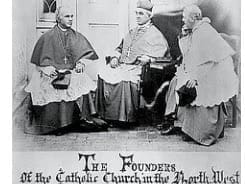
In 1846, the first archbishop of Oregon, French Canadian-born Francis Norbert Blanchet, was eager to obtain significant relics to place under the altars of Catholic churches in Oregon, as was required to say the Divine Liturgy.
He traveled to Italy seeking seminarians for mission work in Oregon and reliquaries for church altars. In a newly discovered part of the 17 miles of Rome’s Domitilla catacombs, which had been sealed for 1,000 years, he and other priests retrieved the remains of four martyrs.
The remains fell to dust when touched. Blanchet gathered up dust, bones, and glass shards from a vessel that had held the blood of a martyr. Relics of four saints—Saint Victoria, Saint Jovian, Saint Severin, and Saint Flavia—were placed in an oblong box and shipped to Oregon on the Etoile du Martin.
The only other church housing these relics that still stands is St. Paul’s, built in 1846 in Saint Paul. It remains the oldest Catholic church in Oregon and the oldest brick building in the Pacific Northwest.
Mid-Century Urban Renewal and the Move to Slabtown
The 1960s were a challenging time for American Catholics as many questioned church teachings regarding divorce and birth control. Relics and iconography were no longer seen as in line with the modern world.
Concurrently, Vatican II allowed Catholics to join the mass migration to the suburbs, leaving neighborhoods like Slabtown and South Portland to be deemed blighted and set for redevelopment by the Portland Development Commission. Their decline owed partly to federal Home Owners’ Loan Corporation maps that in 1937 red-lined nine inner-city neighborhoods as unfit for investment.
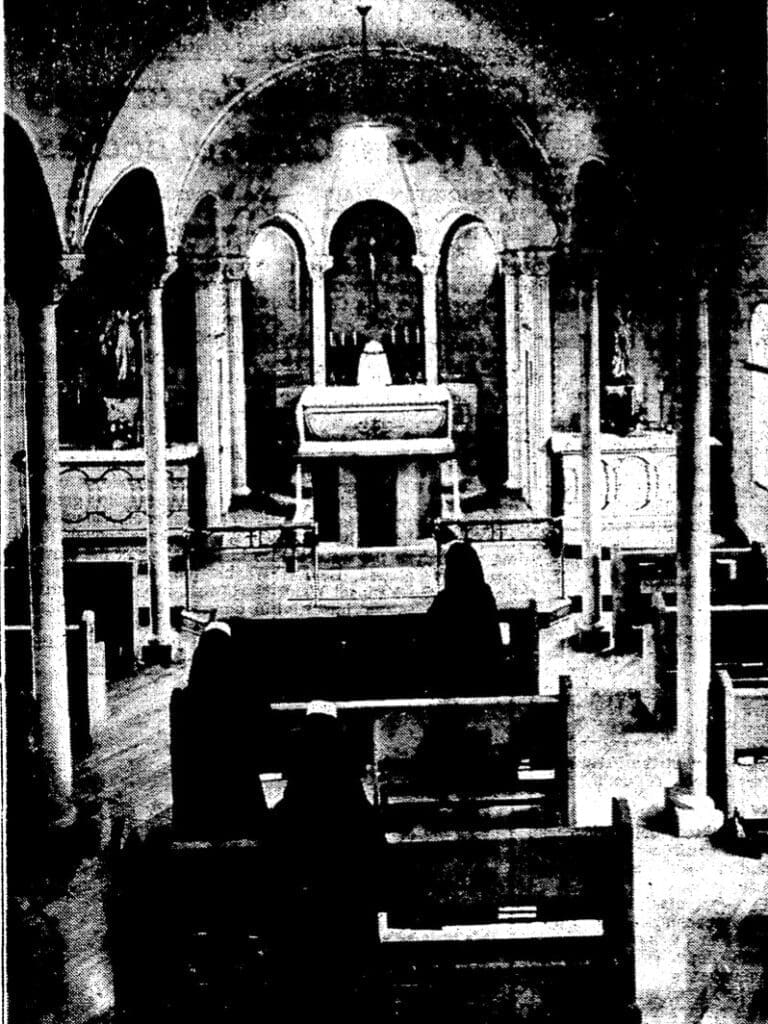
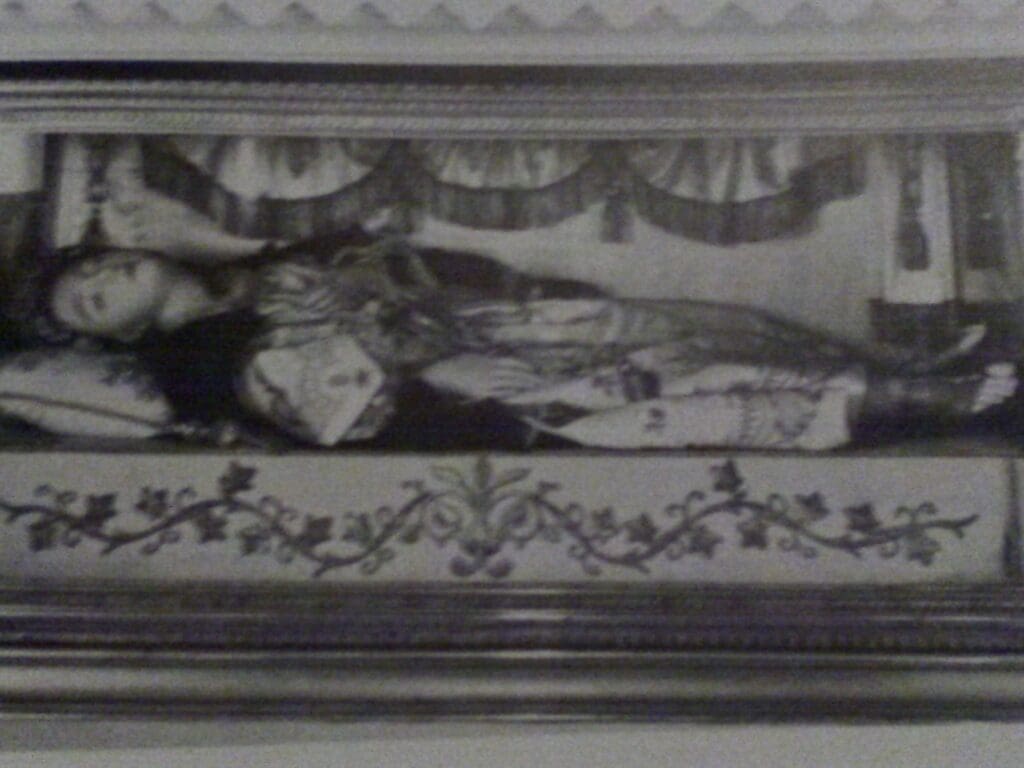
During this era, a March 17, 1967, article in The Oregonian described the striking visual impact of her display:
“The wax figurine of the bleeding St. Flavia is clad in richly textured cloth and riches—and her ever presence asks the students today to have the same faith as St. Flavia had during the early Christian era.”
When a neighborhood movement stopped the Vaughn Street Urban Renewal Project, they saved St. Patrick Catholic Church from demolition just as another historic church holding the relic of Saint Flavia was leveled.
It was not until 1969, when that original church was demolished, that her remains—by then displayed in a silver box inside a life-size wax doll—were moved to St. Patrick Catholic Church at Northwest 19th and Savier streets. 1969 was also the year the Catholic Church eliminated the rule under the Second Council of Nicaea of 787 requiring holy relics at altars. However, tradition still calls for their preservation if possible.
The question of authenticity remains a vital part of historical and liturgical study. As Father Edward McNamara, professor of liturgy at the Regina Apostolorum Pontifical University, noted:
“The greatest care must be taken to determine whether the relics in question are authentic; it is better for an altar to be dedicated without relics than to have relics of doubtful authenticity placed beneath it.” -Father Edward McNamara