
Last Updated on June 29, 2026
Portland’s History of Building Placards: From Vice to Earthquake Safety
On October 3, 2018, the Portland City Council voted on a proposed placard ordinance. The plan was to require owners of unreinforced brick buildings (URMs) to post public warnings stating their structures are unsafe in an earthquake.
This proposal has sparked intense debate, but it begs a historical question: Has Portland ever required placards on buildings in the past?
The short answer is yes. Over the years, both the City of Portland and the State of Oregon have required property owners to place various signs and placards on their structures. Here is a look back at the history of Portland’s building placards.
1. The 1913 Tin Plate Ordinance: Targeting Vice
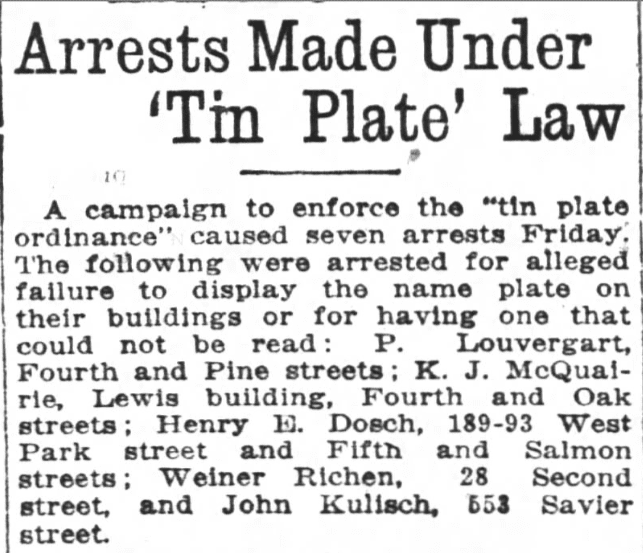
The earliest case of “scarlet letter” placarding uncovered by our history detective team is the 1913 Tin Plate Ordinance.
Much like the modern earthquake safety proposal, the original intention was to pressure landlords through public exposure. In 1912, city officials were attempting to clean up local vice. At the time, renting out buildings to be used as brothels was incredibly profitable for property owners. Ordinance drafters believed that forcing landlords to display their names publicly on the buildings would curb the practice, as owners would not want their names publicly associated with prostitution.
“Is there any hardship on anybody to merely acknowledge what he owns?” > — Oregon Daily Journal, October 29, 1912 (p. 8)
2. The 1975 Historic Properties Plaque: Tax Incentives
Starting in 1975, a different kind of placard appeared. Historic buildings in Portland participating in the state’s Special Assessment of Historic Properties program—a property tax abatement initiative—were required to post a plaque.
As part of the oldest program of its kind in the country, owners who wanted to qualify for the property tax freeze had to install an approved plaque provided by the Oregon State Historic Preservation Office (SHPO).
Note: This requirement is similar to, but distinct from, the symbolic bronze plaques that owners of properties listed in the National Register of Historic Places may choose to purchase and display.
3. The 2007 Red “U” Signs: Fire Safety
In 2007, Portland’s fire marshal began posting red “U” signs on specific local buildings.
These placards serve a vital safety purpose: they warn firefighters in the field that a building is structurally unsafe, alerting them to check with dispatch regarding specific safety precautions before entering. While many assume the “U” stands for vacant, it actually stands for “Unsafe”—and many buildings bearing this red sign remain occupied.
Choice vs. Mandate in Portland’s History
When looking at the broad timeline of Portland’s placarding laws, building owners have almost always had a choice to avoid the sign:
- Stop renting to prostitutes.
- Pay the full property tax rate.
- Bring the building up to modern fire code.
- Bring the building up to seismic code.
As history shows, public signage has long been a tool used by the city to shape owner behavior and protect the public.